

 0
0


Banner Image Courtesy of MatterHackers
What is OBC Filament?
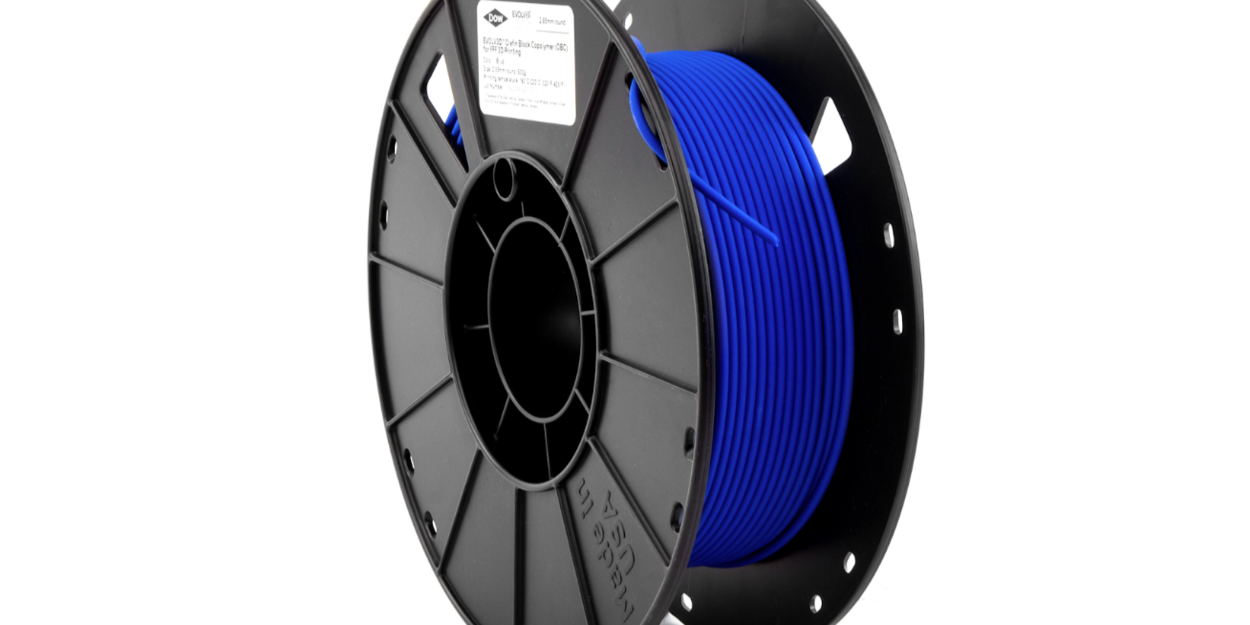
Olefin Block Copolymer (OBC) filament is a polyethylene-based material developed by Dow Chemical that combines the flexibility of elastomers with the durability of rigid plastics. Unlike traditional polypropylene (PP), which is notoriously difficult to print, OBC offers ease of processing, excellent dimensional stability, and chemical resistance.
The innovation lies in its block copolymer structure, alternating “hard” and “soft” segments that give OBC a unique balance of strength, flexibility, and fatigue resistance. OBC filament is an ideal FDM material for demanding applications.
Properties of OBC Filament
OBC filament is known for its mechanical and environmental resilience. Key properties include:
• Flexibility & Toughness: High elongation at break and impact resistance make it ideal for parts that bend or absorb shock.
• Chemical Resistance: Withstands alcohols, solvents, and even stronger chemicals without degrading.
• Lightweight: Low density compared to PC or ABS, reducing part weight while maintaining durability.
• Fatigue Resistance: Exceptional performance in living hinges, bellows, and parts subject to repeated stress.
• Environmental Resistance: Resistant to UV, moisture, and stress cracking, making it suitable for outdoor and marine use.
• Ease of Printing: Unlike PP, OBC adheres better to common build surfaces and exhibits lower warping.
Applications of OBC Filament
• Automotive & Aerospace: Lightweight, chemical-resistant components such as clips, housings, and ducts.
• Marine & UAVs: Durable parts exposed to saltwater, solvents, or harsh weather conditions.
• Consumer Products: Living hinges, flexible joints, bellows, and bendable parts that require repeated motion.
• Medical & Laboratory: Solvent-resistant containers, tubing, and components that must withstand sterilization.
• Industrial Prototyping: Functional prototypes requiring toughness and flexibility beyond PLA or PETG.
Printing Guidelines
Printing OBC requires attention to detail, but it is far easier than polypropylene.
Recommended settings include:
1. Nozzle Temperature: 195–215 °C
2. Bed Temperature: 90–105 °C
3. Print Speed: 20–40 mm/s
4. Cooling Fan: 25–50% after the 5th layer; avoid excessive cooling to prevent brittleness
5. Bed Adhesion: Use PEI sheets, Magigoo PP adhesive, or a brim/raft for better grip
6. Enclosure: Not strictly required, but helps with dimensional stability
Tips:
1. Keep fan speed moderate due to filament flexibility
2. Use rafts or brims for large parts to reduce warping
3. Avoid overhangs without support, as OBC is softer than rigid filaments
Comparison with PP and PC Filaments
|
Property |
OBC |
Polypropylene (PP) |
Polycarbonate (PC) |
|
Ease of Printing |
Easier, lower warping |
Difficult, poor adhesion |
Moderate, requires high temps |
|
Flexibility |
High, excellent fatigue resistance |
Good, but brittle under stress |
Low, rigid and tough |
|
Chemical Resistance |
Excellent |
Excellent |
Moderate |
|
Strength & Impact Resistance |
Strong, flexible |
Moderate |
Very high |
|
Density |
Low (lightweight) |
Low |
Higher (heavier) |
|
Applications |
Hinges, bellows, UAVs |
Packaging, automotive |
Safety gear, lenses |
FAQs
Q: Is OBC filament easy to print compared to polypropylene?
A: Yes. OBC adheres better to build surfaces and has lower warping, making it significantly easier to print than PP.
Q: What bed surface works best for OBC?
A: PEI sheets or adhesives like Magigoo PP are recommended for strong adhesion.
Q: Can OBC filament withstand solvents?
A: Absolutely. OBC is resistant to alcohols, cleaning agents, and stronger solvents, making it ideal for lab and industrial use.
Q: Is OBC suitable for outdoor applications?
A: Yes. Its UV and moisture resistance make it reliable for marine, UAV, and outdoor automotive parts.
Q: How does OBC compare in cost to PLA or ABS?
A: OBC is generally more expensive due to its advanced properties, but the durability and performance justify the investment for specialized applications.
Q: Does OBC filament require an enclosure for printing?
A: Not necessarily. While an enclosure can help maintain dimensional stability, OBC prints well without one due to its low warping property.
Q: How does OBC handle mechanical fatigue compared to other flexible filaments?
A: OBC excels in fatigue resistance. It can endure repeated bending and flexing without cracking, making it superior to PLA and even TPU in applications like living hinges.
Q: Is OBC filament recyclable?
A: Yes. As a polyolefin-based material, OBC aligns with existing recycling streams better than mixed polymers, offering potential for sustainable manufacturing practices.
Q: Can OBC filament be used for food-contact applications?
A: Potentially. OBC’s chemical resistance and non-toxic nature make it a candidate for food-safe printing, but certification depends on the manufacturer and regulatory standards. Always check product specifications before use.
Q: What industries benefit most from OBC filament?
A: Industries such as automotive, aerospace, marine, medical, and consumer goods benefit from OBC’s unique balance of flexibility, durability, and chemical resistance. It is especially valuable where parts must withstand solvents, stress, and repeated motion.


